Genloop MCP: How Model Context Protocol Brings Governed Analytics to Every AI Agent
Model Context Protocol (MCP) is an open standard that lets AI agents query external tools and data sources without a bespoke integration for each combination — and Genloop's MCP server is the mechanism that makes enterprise analytics queryable inside Claude, custom agents, and any MCP-compatible environment while keeping RBAC, RLS, and column-level security fully intact. For engineering directors and data leaders evaluating AI-native analytics stacks, the operational implication is direct: a store operations manager can ask a governed data question inside Claude and receive an accurate, access-controlled answer — without opening a BI dashboard, granting superuser credentials, or writing a line of SQL.
| Metric | Value | Source |
|---|
| NL2SQL benchmark ranking | #1 on Spider 2.0 and LiveSQL | Genloop benchmark data |
| Production query accuracy | 95% | Genloop retail deployment (2,500+ stores) |
| Data sources joined in a single deployment | 4+ | Genloop retail case study |
| Production timeouts | Zero | Genloop retail case study |
| BI vendors with published MCP implementations | 5 (ThoughtSpot, Sisense, Qlik, Metabase, Genloop) | Vendor blog posts, August 2026 |
MCP shifts the analytics access model from "go to the BI tool" to "the BI tool comes to where decisions are made." Traditional analytics access requires a user to open a dashboard, learn a query interface, or submit a ticket to an analyst. MCP creates a protocol layer through which any compliant AI agent can request data from a governed platform and receive a structured, permission-respecting response — without the user changing tools.
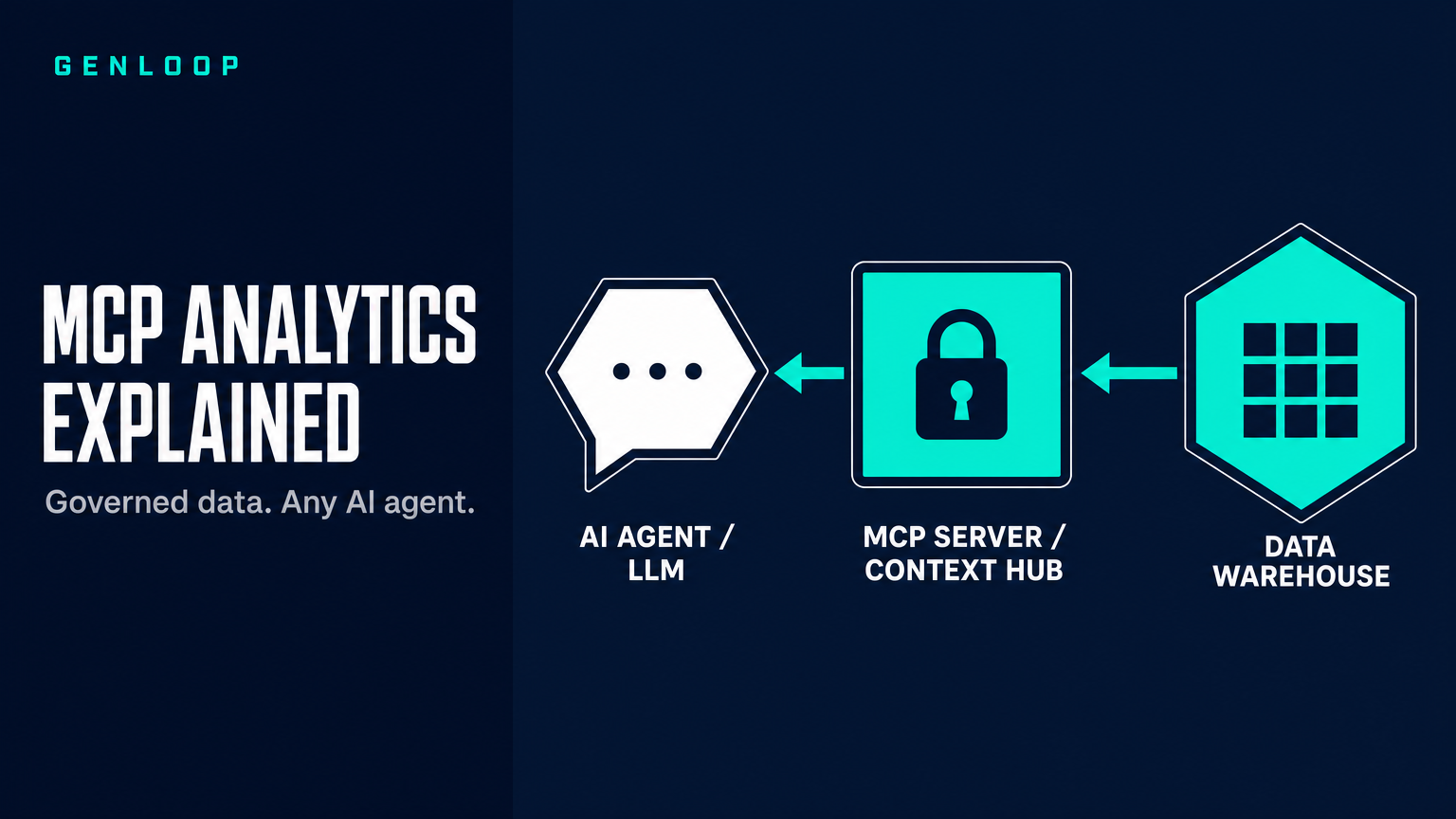
Model Context Protocol defines a standard communication format: an agent makes a structured request to an MCP server, the server applies its internal logic and access controls, and it returns a response the agent can reason over. The agent never connects directly to the underlying warehouse. For analytics, this means the BI platform — not the LLM — controls what data is returned and to whom.
Engineering teams building NL2SQL agents consistently report the same friction: making warehouse data accessible to an LLM pipeline while preserving the access controls that enterprise security and compliance require. Discussion threads on r/dataengineering confirm that teams are actively building MCP-compatible analytics pipelines, and the primary unresolved tension is governance — most warehouse-direct approaches expose too much or require redundant permission layers. See why AI agents acting on enterprise data still require a governed architecture layer for the architectural case in full.
Genloop's Slack Integration already demonstrates the "data in the workflow" pattern — a team member asks a data question inside Slack and receives a governed, NL2SQL-powered answer without leaving their communication tool. Genloop MCP generalises this pattern to any MCP-compatible environment: Claude, a custom internal agent, an operations workflow tool, or any future MCP client. The governance layer is the same in both cases; only the surface changes.
The Bottom Line: MCP is not a chatbot feature — it is an architectural shift that makes the governed analytics layer queryable from wherever work actually happens.
The critical question for enterprise teams is not whether MCP works, but whether it preserves the access controls that make enterprise data safe to expose. Genloop MCP enforces the same RBAC, RLS, and column-level security (CLS) that govern human users — an external agent does not receive elevated permissions simply because it is a machine.
When an AI agent queries through Genloop MCP, the request flows through Genloop's Context Hub — the governed semantic layer that sits between the agent and the underlying warehouse. The Context Hub applies the access policy associated with the authenticated identity: the agent sees exactly what that identity is permitted to see, nothing more. The warehouse itself is never exposed directly to the agent, and no warehouse credentials are passed to the calling LLM.
An agent acting on behalf of a regional store manager with RLS scoped to that manager's region returns only that region's data — even if the agent's prompt asks for company-wide revenue. The RLS filter is applied at the Context Hub layer, not by the LLM and not by the agent's prompt. This is the distinction that separates a governed MCP implementation from a raw NL2SQL pipeline pointing at a warehouse: the BI platform, not the model, enforces the boundary.
For a detailed treatment of how a governed semantic layer determines the reliability of conversational analytics, the architectural connection between Genloop's Context Hub and MCP is explored in that post.
Compliance Posture
Genloop is SOC2 Type II and ISO 27001 compliant. These certifications cover the platform's data handling, and MCP queries run through the same compliant infrastructure as all other Genloop interactions — no separate compliance posture is required for MCP-connected agents.
The Bottom Line: Genloop MCP enforces the same RBAC, RLS, and CLS controls on external agents as on human users — an agent cannot retrieve data its associated identity is not authorised to see.
Multiple BI vendors have published MCP implementations in 2026, which confirms this is the current architectural frontier for enterprise analytics. The implementations differ materially in what agents can access and whether governance is preserved.
| Vendor | MCP availability | Governance preserved? | What agents can access |
|---|
| Genloop | Growth ($200/mo) and Enterprise plans | Yes — RBAC, RLS, CLS enforced at Context Hub | Governed NL2SQL queries via Context Hub semantic layer |
| ThoughtSpot | Published (Spotter) | Partial — depends on Spotter configuration | Spotter AI search and analysis via Claude/custom agents |
| Sisense | Published (assistant MCP server) | Partial — LLM-flexible integration | Sisense assistant queries via flexible LLM layer |
| Qlik | Published (embedded analytics) | Partial — embedded context | Embedded Qlik analytics surfaces via MCP |
| Metabase | Published (Claude skill) | Limited — skill-based scoping | Metabase question and dashboard data via Claude |
Sources: ThoughtSpot MCP blog, Sisense MCP blog, Qlik MCP blog, Metabase MCP blog.
All five vendors publishing on MCP are solving the same core problem: making their analytics layer callable from an external agent. The differentiation is in what sits between the agent and the warehouse. Implementations that route through a governed semantic layer — rather than exposing the warehouse or a thin API shim — are the ones that can honestly claim governance is preserved. For teams evaluating this category, the right question to ask any vendor is: "When an external agent queries through your MCP server, which access controls apply and where are they enforced?"
The Bottom Line: Early-mover BI vendors are converging on MCP as the standard protocol for agent-queryable analytics — but governance preservation varies significantly across implementations.
MCP integration is most valuable in workflows where a decision-maker already uses an AI agent and the data question is part of that workflow — not a reason to switch tools. The following matrix covers the primary use cases.
| Use case | How MCP enables it | Governance mechanism | Example |
|---|
| Operations Q&A inside Claude | Agent calls Genloop MCP server mid-conversation | RLS scopes response to user's authorised data | Regional ops lead asks Claude for underperforming store count; receives region-scoped answer |
| Custom internal agent with data access | Agent calls Genloop MCP as one of multiple tools | RBAC restricts which metrics and dimensions are visible | Finance agent pulls revenue by segment without warehouse access |
| Automated investigation triggered by alert | Monitoring agent queries Genloop on anomaly | CLS prevents exposure of restricted columns | Anomaly detected in sales data; agent queries root-cause dimensions it is permitted to see |
| Multi-tool agent workflow | Agent orchestrates Genloop MCP + CRM + forecasting tool | Genloop enforces governance; other tools handle their own | Sales agent combines pipeline data from CRM with actuals from Genloop |
Genloop's Slack Integration delivers governed analytics answers inside a specific channel. MCP generalises the same capability to any MCP client — the surface is unbounded by design. A team that has already adopted Genloop's Slack Integration has validated the "data in the workflow" pattern; MCP is the mechanism that extends it to Claude, internal agents, and any future MCP-compatible tool without re-engineering the governance layer.
Production Accuracy in Context
Genloop's production deployment serving 2,500+ retail stores achieved 95% query accuracy across 4+ joined data sources with zero timeouts. The same NL2SQL engine and Context Hub that produced those results are what MCP-connected agents query — MCP adds a new access surface, not a different underlying model.
The Bottom Line: MCP's primary operational value is eliminating the tool-switch tax — the data question is answered in the workflow where the decision is being made.
Not every integration requirement calls for MCP. The table below maps each pattern to the scenario where it fits.
| Integration type | Best for | Governance level | Developer effort |
|---|
| Genloop MCP | AI agents and LLMs querying data mid-workflow | Full — RBAC, RLS, CLS enforced by Context Hub | Low — agent speaks MCP protocol; no custom connector |
| Genloop API | Internal applications and BI workflows that need programmatic query access | Full — same governance layer | Medium — requires API integration and auth handling |
| Embedded Analytics (iframes) | External-facing products or internal portals where a data surface is embedded in a UI | Full — RBAC/RLS scoped per embed context | Medium — iframe configuration and SSO/SAML setup |
| Raw warehouse connection | Data engineering pipelines that need direct table access | None enforced by BI layer — must be built separately | High — custom auth, governance, and query logic required |
MCP is the right pattern when the consumer of the data is an AI agent operating inside an LLM session — Claude, a custom agent, or an orchestration framework. An API is the right pattern when the consumer is a deterministic application that needs structured query results for a defined workflow. The distinction is the nature of the consuming system: agentic and conversational favours MCP; deterministic and application-driven favours API.
Embedded analytics via iframes remains the right pattern when a human user needs a governed data surface inside an internal tool or external product — and that user is interacting with a UI, not an AI agent. MCP and embedded analytics address different surfaces and are not mutually exclusive; an enterprise deployment can use both.
For what enterprise analytics teams actually need from AI, the distinction between agentic and embedded access patterns is covered in full.
The Bottom Line: MCP is purpose-built for AI agents; API is for deterministic applications; embedded analytics is for human users in external UIs. Choosing the right pattern depends on who — or what — is consuming the data.
| Feature | Growth plan | Enterprise plan |
|---|
| MCP access | Included | Included |
| Price | $200/month (1,000 credits) | Custom pricing |
| DB connections | Up to 10 (up to 100 tables) | Unlimited |
| Members | Up to 200 | Unlimited |
| Governance | RBAC, RLS | RBAC, RLS, CLS, custom roles, SSO/SAML |
| Deployment | Standard SaaS | VPC / air-gapped available |
| Support | Priority support | Dedicated Solutions Architect + SLA |
MCP as a protocol is evolving rapidly. The capabilities described in this post reflect Genloop's current MCP implementation; specific protocol versions and server capabilities are subject to change as the broader MCP ecosystem — maintained by Anthropic and the open-source community — develops. Teams building production MCP pipelines should monitor protocol version compatibility between their agents and any MCP server they depend on.
Governance enforcement through MCP is only as strong as the identity the agent authenticates as. If an agent is configured with a highly permissioned service account, the RLS and RBAC scoping will reflect that account's access level — which may be broader than intended. Enterprises should apply the principle of least privilege to the identities used in MCP-connected agent workflows, the same discipline applied to service accounts in any other integration context.
MCP integration does not replace the need for a well-structured semantic layer. An agent querying through Genloop MCP benefits from the Context Hub's self-learning metric definitions and schema understanding — but an organisation that has not invested in defining its metrics and business logic will receive accurate access-controlled answers to poorly defined questions. Semantic layer reliability in practice covers this dependency in detail.
Finally, MCP introduces a new query surface that security teams should audit. While Genloop MCP enforces the same controls as the human-user interface, any new integration point expands the attack surface. Rate limiting, audit logging of agent queries, and identity governance for service accounts used in MCP workflows are all hygiene requirements for enterprise deployments.
Teams running self-serve analytics entirely through a human-facing interface — dashboards, shared Liveboards, or direct Slack queries — who have no current plans to build or deploy AI agents do not need MCP today. Genloop's Slack Integration and embedded analytics cover those workflows. MCP becomes relevant when the team is actively building or adopting LLM-based agents and wants those agents to query governed enterprise data as part of an existing workflow.
What is Model Context Protocol (MCP)?
Model Context Protocol (MCP) is an open standard, maintained by Anthropic and the broader MCP ecosystem, that defines how AI agents and large language models connect to external tools, data sources, and services. It gives an LLM a structured way to call a tool — such as a BI platform — and receive a governed response, without requiring a custom integration for each combination of agent and data source.
An analytics platform exposes an MCP server — a layer that translates incoming agent requests into governed data queries. When an AI agent asks a data question, it calls the MCP server, which applies the platform's access controls, runs the query against the underlying warehouse, and returns a structured response. The agent never touches the warehouse directly; all query logic and permissions enforcement stay inside the analytics platform.
Yes. MCP-compatible agents — including Claude and custom-built agents — can query enterprise data through an MCP server. With Genloop MCP, the agent queries Genloop's Context Hub, which sits in front of the warehouse. The agent receives only the data its associated user identity is authorised to see, under the same RBAC and RLS rules that govern human users. No warehouse credentials are exposed to the agent.
Not with Genloop MCP. The MCP server enforces the same row-level security (RLS), role-based access control (RBAC), and column-level security (CLS) that apply to human users querying through the Genloop interface. The external agent inherits the permissions of the authenticated identity it is acting on behalf of — it does not receive superuser access to the underlying warehouse.
A traditional analytics API requires a developer to write a custom integration: define endpoints, handle authentication, parse responses, and manage schema changes. MCP is a universal protocol — an agent that speaks MCP can connect to any MCP server without a bespoke integration. For analytics, this means a single agent can query Genloop, retrieve CRM data, and call a forecasting model in one session using the same protocol, reducing integration engineering by eliminating per-source connectors.
As of August 2026, vendors with published MCP implementations include ThoughtSpot (Spotter in Claude and custom agents), Sisense (MCP server for flexible LLM integration), Qlik (embedded analytics via MCP), Metabase (Claude skill integration), and Genloop (MCP server on Growth and Enterprise plans). Implementations differ in whether they preserve governance controls when an external agent queries through the MCP layer.
Genloop MCP is available on the Growth plan ($200/month, up to 10 DB connections and 200 members) and the Enterprise plan (custom pricing, unlimited connections and users, with VPC and air-gapped deployment options). It is not included in the Free or Pro tiers.
Genloop MCP makes enterprise analytics queryable from Claude, custom agents, and any MCP-compatible environment — with the same RBAC, RLS, and column-level security that govern human users. For teams building AI-native workflows where governed semantic layer vs. conversational BI is already a design decision, MCP is the next architectural step. Explore Genloop's Growth and Enterprise plans at genloop.io.